Friday, 6 January 2023

Future Continuous Tense


Future Continuous Tense


TENSES

The word ‘tense’ is derived from Latin word ‘tempus’ and it means time. Basically tense conveys the time of action.

Tenses are mainly divided into parts – Present, Past and Future. They are further subdivided into three categories – Indefinite, Continuous, Perfect and Perfect Continuous.


PRESENT TENSE

PAST TENSE

FUTURE TENSE

PRESENT INDEFINITE

PAST INDEFINITE

FUTURE INDEFINITE

PRESENT CONTINUOUS

PAST CONTINUOUS

FUTURE CONTINUOUS

PRESENT PERFECT

PAST PERFECT

FUTURE PERFECT

PRESENT PERFECT CONTINUOUS

PAST PERFECT CONTINUOUS

FUTURE PERFECT CONTINUOUS


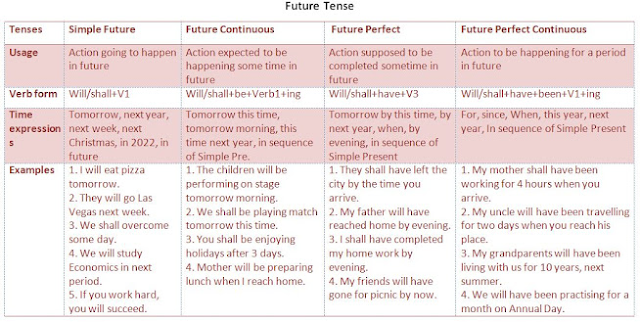
FUTURE TENSE AT A GLANCE


FUTURE CONTINUOUS TENSE


FUTURE CONTINUOUS TENSE is generally used to describe actions that will be happening at certain time in future. It is also known as Future Progressive Tense.


Usage of Future Continuous Tense


1. The Future Continuous Tense is used to express the actions that will be in progress at some time in future

e.g. 1. We will be performing on stage at this time tomorrow. (action in progress in future)

Father will be reaching in 10 minutes. (action to be happening in near future)


2. This tense is used to express an action that is fairly certain to be happening in future

  e.g.   Next week PM will be addressing the nation. (certain to be happening in future)

           They won't be coming back before evening. (sure not to happen)


3. It is used for planed future events/decisions.

e.g. We will be going to Malaysia next month. (planned event in future)

 We will be celebrating Deepawali on coming Monday. (event of future)


4. This Tense is used to express the future event in sequence of simple present

e.g. Mother will be cooking when we reach there. (in sequence of simple present)

 Video on Future Tense

Time Expressions used in this tense

Adverbs/adverb phrases used in the tense

            tomorrow                            tomorrow this time

            next week                             next year

            in evening                             coming week

            next year this time             this evening

            coming holidays                 this Christmas

            in 10 minutes                      after some time


Verb Form used in this tense

Basic structure of a sentence in this tense is Subject + will/shall + be + ing form of Verb + Object ( S+V+O )

Two elements of verb forms used in this tense are :

1. appropriate modal auxiliary ‘shall/will’

2. Base form of the verb ‘Be’ - be

3. Present participle form (V1+ing) of main verb


Will/shall + be

Present Participle form – verb 1 + ing

You shall be

giving final exams this time next year.

Shyam will be

leaving for Mumbai next morning.

She will be

reaching the station in 10 minutes.

I shall be

enjoying my summer break next month.

They will be

going to watch a movie in evening.

My grandparents will be

arriving today.


Uses of Will and shall


We generally use ‘shall’ with I and we.

For other pronouns you, they, she, he, it ‘will’ is used generally

Will is used for certainty, confirmation, assurance, decision or plan and shall is used for promise, hope, request, suggestion and offer of help. Shall is more formal and literary; will is used more commonly and more frequently now a days.


Uses of ‘Will’ :

Will is used for certainty, confirmation, assurance, decision or plan. It is used more common and generally used with friends, family, every day life and in spoken English.


1. when we decide to do something at the time of speaking (descision) -

Examples:

I will have a glass of orange juice.

She will lie down for some time as she is tired.


2. to express the plan of the speaker -

Examples:

I will consult a specialist for my eye problem.

I will not go for a walk as it is very humid.


3. When speaker is assured/confirmed to do something -

Examples :

I will clean my room.

I will pay your telephone bill.


4. to request somebody to do something

Example:

Will you bring my bag please?


5. to promise to do something to friends -

Example:

I will help you in the Science assignment.


Uses of ‘Shall’ :

These days ‘shall’ is mainly used to ask for favour, make promise, to give suggestions or to make offers, seek or offer help. 'Shall' is more formal and literary.


1. To make polite or formal request -

Examples:

Shall we go for a coffee please?

Shall we leave now? (question)


2. To make polite or formal suggestion -

Examples:

Shall we go and clean the community park?

Shall we take the children to the circus this Sunday?


3. to make a promise –

Examples:

I shall always be there with you.

You shall see the difference yourself.


4. to make an offer of help -

Examples:

Shall I call the cab for you?

Shall I lay the table for dinner?


5. to hope for something good –

Examples:

We shall win this competition.

We shall meet again.

We shall overcome.

Video on Usage of Will or Shall

Note : Two future tenses can’t be used in a sentence, in case of two clauses, one clause should be in simple present tense while the other in any of the future tenses.


MORE EXAMPLES :

1. The children will be performing on stage next morning.

 2. We shall be playing match tomorrow this time.

 3. You shall be enjoying holidays after 3 days. (Adverb phrases)

 4. Mother will be preparing lunch when I reach home. (Adverb clause)

 5. I will be staying here till Sunday.

 6. When I get home, my children will be playing. (Adverb Clause)


Exercise for practice


1.     My cousins _________ here any time. (reach)

2.     We ____________ on stage tomorrow this time. (perform)

3.      My granny _________ for me at the airport. (wait)

4.     Are you free on Saturday? No, I _________ as usual from 10 to 6. (work)

5.     The Director __________ into these matters himself. (look)

6.     He ________ in Amsterdam from January to August this year. (stay)

7.     My friend _____________ for the birthday party.  (not come)

8.     We _________ in a few minutes. (take off)

9.     We _________ on and off. (meet)

10.     My boss ________for Australia next month. (leave)


Answers :

1. Will be reaching   2. Will be performing    3. Will be waiting   4. Will be working   5. Will be looking 6. Will be staying   7. Won’t be coming   8. Will be taking off   9. Shall be meeting   10. Shall be leaving 


Tuesday, 3 January 2023

Future Indefinite Tense


Tenses

The word ‘tense’ is derived from Latin word ‘tempus’ and it means time. Basically tense conveys the time of action.
Tenses are mainly divided into parts – Present, Past and Future. They are further subdivided into three categories – Indefinite, Continuous, Perfect and Perfect Continuous.

PRESENT TENSE
PAST TENSE
FUTURE TENSE
PRESENT INDEFINITE
PAST INDEFINITE
FUTURE INDEFINITE
PRESENT CONTINUOUS
PAST CONTINUOUS
FUTURE CONTINUOUS
PRESENT PERFECT
PAST PERFECT
FUTURE PERFECT
PRESENT PERFECT CONTINUOUS
PAST PERFECT CONTINUOUS
FUTURE PERFECT CONTINUOUS


FUTURE TENSE AT A GLANCE


SIMPLE FUTURE TENSE OR FUTURE INDEFINITE TENSE

FUTURE INDEFINITE TENSE is generally used to describe actions that are going to occur in the coming time, near or far future. It is also known as Simple Future Tense.


VERB FORMS USED IN SIMPLE FUTURE TENSE


Basic structure of a sentence in this tense is Subject + will/shall  + Verb 1 + Object 

Two elements of verb forms used in this tense are :

1. appropriate modal auxiliary ‘shall/will’

2. Verb's first form is used (V1 - first form of main verb)


TIME EXPRESSIONS


Usage of Future Indefinite Tense


1. The Simple future tense is used to express an action that is going to take place in future near or far.

e.g. The teacher will teach Tenses tomorrow. (going to happen in near future)

      Father will come back in evening. (near future-routine)

2. The Simple future tense is used to express an action that is likely to take place in future.

  e.g.   I don’t think he will pass. (likely to happen)

           They won't come back before evening.

3. It is used for future plans/decisions about future

e.g. I shall pay the rent next week. (future decisions)

      The company will buy two more machines next month. (plan)

      The scheme will be launched next month. (plan)

4. This Tense is used to express the things that are sure to happen in future, something that can not be changed, which is beyond our control - 

The school will remain closed tomorrow. (sure to happen in future)

The buses will not ply tomorrow due to strike.


Note : Apart from will and shall, 'about to', 'going to' and 'is to' are also used to express actions in future which is known as future time reference.


Uses of Will and shall


We generally use ‘shall’ with I and we.

For other pronouns you, they, she, he, it ‘will’ is used generally

Will is used for certainty, confirmation, assurance, decision or plan and shall is used for promise, hope, request, suggestion and offer of help. Shall is more formal and literary; will is used more commonly and more frequently now a days.


Uses of ‘Will’ :

Will is used for certainty, confirmation, assurance, decision or plan. It is used more common and generally used with friends, family, every day life and in spoken English.


1. when we decide to do something at the time of speaking (descision) -

Examples:

I will have a glass of orange juice.

She will lie down for some time as she is tired.


2. to express the plan of the speaker -

Examples:

I will consult a specialist for my eye problem.

I will not go for a walk as it is very humid.


3. When speaker is assured/confirmed to do something -

Examples :

I will clean my room.

I will pay your telephone bill.


4. to request somebody to do something

Example:

Will you bring my bag please?


5. to promise to do something to friends -

Example:

I will help you in the Science assignment.


Uses of ‘Shall’ :

These days ‘shall’ is mainly used to ask for favour, make promise, to give suggestions or to make offers, seek or offer help. 'Shall' is more formal and literary.


1. To make polite or formal request -

Examples:

Shall we go for a coffee please?

Shall we leave now? (question)


2. To make polite or formal suggestion -

Examples:

Shall we go and clean the community park?

Shall we take the children to the circus this Sunday?


3. to make a promise –

Examples:

I shall always be there with you.

You shall see the difference yourself.


4. to make an offer of help -

Examples:

Shall I call the cab for you?

Shall I lay the table for dinner?


5. to hope for something good –

Examples:

We shall win this competition.

We shall meet again.

We shall overcome.


Note : Two future tenses can’t be used in a sentence, in case of two clauses, one clause should be in simple present tense while the other in any of the future tenses.


MORE EXAMPLES :

1. I will eat pizza tomorrow.

2. They will go Las Vegas next week.

3. We shall overcome some day.

4. We will study Economics in next period.

5. If you work hard, you will succeed. (condition)

6. Tomorrow I will be 18 years old

Video on Future Tense

Exercise for practice 


1.     Mr. Smith _________ us today. (not teach)

2.     He _______ always _______ care of his sister. (take)

3.      My granny _________ me at the airport. (meet)

4.     We _________ every day for an hour from now for better result. (study)

5.     Aunt Lisa __________ cookies for my birthday party. (bake)

6.     This bridge ________ ready for use by the end of this year. (be)

7.     ______ you ________ with us for the party?  (not come)

8.     _______ I _________ you to the party? (accompany)

9.     If God wills, we _________ again. (meet)

10.        I ________ a chilled coke with banana chips. (take)

Video on use of will or shall


Answers :

1. will not teach   2. Shall, take    3. Will meet   4. Will study   5. Will bake

6. will be   7. Won’t, come   8. Shall, accompany   9. Shall meet   10. Will take